
Most people walk through a factory without paying attention to all the unseen mechanics working behind the scenes until something goes wrong and pokes its head out above ground level. The hum of all these moving parts goes on in a steady, predictable fashion, and life is normal until something breaks, causing complications as all these machines come grinding to a halt.
Reliability isn’t optional for these chains because they’re expected to run every single day.
Industrial Chains by Rockman
Rockman manufactures different types of industrial chains designed for demanding applications. These include:
- Conveyor chains used to move materials in production systems
- Transmission chains used to transfer power between machines
- Heavy-duty chains built for tough industrial work
These chains are made for continuous operation where strength and durability matter the most.
Where industrial chains are used
Industrial chains have their use in different industries, such as:
- Manufacturing and processing plants
- Conveyer systems and material handling systems
- Industrial automation systems
- Agricultural equipment and heavy equipment
Unlike automotive chains, industrial chains often work in difficult conditions. They may run:
- Continuously for long periods
- Under constant heavy load
- In dusty, hot, wet, or dirty environments
Because of this, their performance directly affects productivity and machine uptime.
How Industrial Chains Are Designed
Industrial chains are designed very carefully to handle demanding work.
They are built to:
- Carry heavy loads safely
- Work for long operating hours
- Stay stable under constant stress
- Resist wear in tough environments
From the type of steel used to the different stages of heat treatment, to the manufacturing itself, all of these are chosen to improve its longevity and performance.
Wear and Chain Life
Over time, all chains experience wear. This usually happens through:
- Gradual wear of pins and bushes
- Chain elongation from continuous load
- Surface damage from dust, heat, or chemicals
The uneven or erratic wear is the problem, despite some wear occurring normally. If wear does not continue to be uniform, it may lead to vibration and misalignment, which in turn may bring down the whole system.
Quality chains are made to wear at a constant rate, which means that maintenance can be planned in advance.
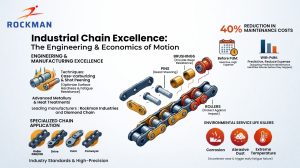
What Happens When a Chain Fails
When an industrial chain fails, the cost is usually much bigger than just replacing the chain.
It can lead to:
- Unexpected production downtime
- Damage to nearby equipment
- Safety risks for workers
- Higher maintenance and repair costs
In many factories, one chain failure can stop an entire production line. This is why choosing the right chain is so important.
Improvements in Industrial Chain Technology
Industrial chains today are more advanced than they were in the past.
Modern improvements include:
- Stronger alloy steels for better load capacity
- Better heat treatment for longer fatigue life
- Surface treatments that reduce wear and corrosion
- More precise manufacturing for smoother operation
These improvements help chains last longer and perform more reliably.
Rockman’s Approach to Reliable Industrial Chains
At Rockman, reliability is the main focus when designing industrial chains.
The goal is to create chains that can handle real working conditions — heavy loads, long operating hours, and tough environments.
Rockman focuses on providing reliable chains through:
- Selecting the best materials to provide maximum strength and durability
- Applying accurate heat treatment to improve fatigue resistance
- Maintaining stringent tolerances during the manufacturing process
- Designing chains that provide reliable and consistent performance
By providing reliable chains at every stage, Rockman ensures that the industries they serve operate with the least downtime.