
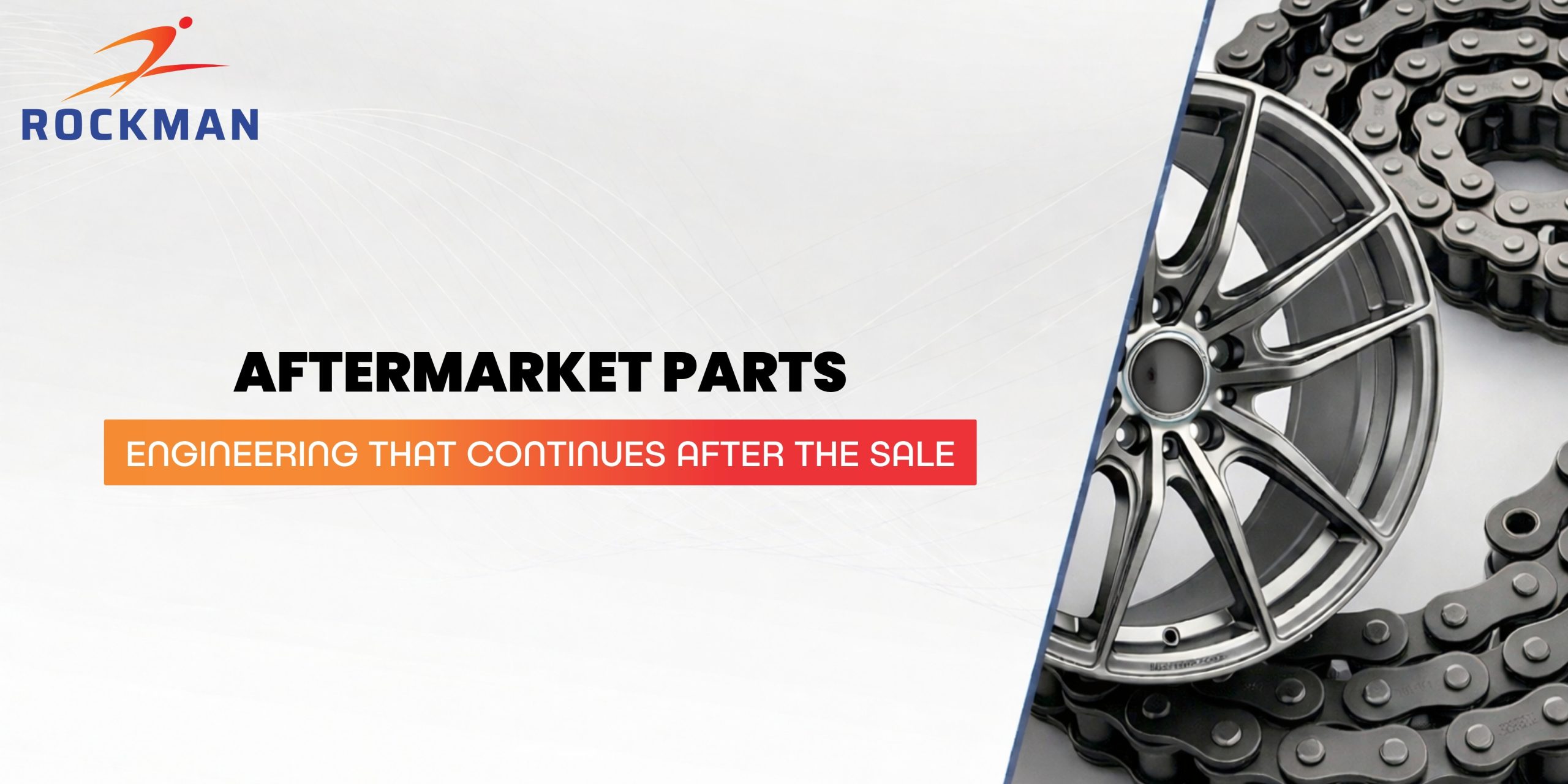
When a vehicle leaves the factory, the job isn’t really “done.” It just changes.
From that point onward, how safe, smooth, and reliable the vehicle remains depends a lot on the parts used to maintain it. That’s where aftermarket parts matter—not as a cheaper backup option, but as a way to keep the vehicle running the way it was meant to.
What Rockman Offers in the Aftermarket
Rockman’s aftermarket range includes:
- Auto chains and chain–sprocket kits
- Alloy wheels
- Clutch assembly
- Brake pads
- Engine oil
- Fork oil
- And many more…
These parts are made for vehicles already on the road. That means strength, correct fit, and consistent performance matter just as much as they do in the original build.
Where Aftermarket Parts Are Used
Aftermarket parts are typically used for:
- Regular maintenance
- Wear-and-tear replacement
- Restoring performance after long use
Unlike parts installed during factory assembly, aftermarket parts face a much wider variety of conditions.
Real-World Conditions Are Tougher Than Factory Conditions
In the real world, every vehicle is treated differently:
- People drive and ride differently
- Maintenance doesn’t always happen on time
- Roads, weather, and usage conditions vary a lot
So aftermarket parts have to work reliably even when conditions are unknown. In many ways, that makes aftermarket engineering more challenging.
Why Replacement Quality Matters
A replacement part doesn’t work alone—it works with other parts around it.
If an aftermarket part is poorly made, it can:
- Wear out nearby components faster
- Reduce efficiency
- Increase noise, vibration, and stress
- Shorten the overall life of the vehicle
The biggest problem is that the damage often doesn’t show up immediately. It builds slowly—through more repairs, worse performance, and sometimes safety issues.
Good quality parts ensure stability in the system and reliability in the vehicle for a long time.
The Risks of Low-Quality Parts
Aftermarket quality can vary a lot, which is why choosing the right part matters.
Poor-quality parts can lead to:
- Early failure
- Wrong or inconsistent fitment
- Extra stress on connected parts
- Hidden safety risks
In areas like drivetrains and wheels, “almost fine” isn’t fine at all. Safety is directly involved.
How the Aftermarket Is Changing
The aftermarket is no longer only about price. The industry is moving toward better standards, including:
- OEM-equivalent quality expectations
- Better traceability and part identification
- Improved compatibility information across models
- More testing and validation for long-term performance
Because customers expect more—and regulations are getting stricter—the gap between OEM parts and high-quality parts is getting smaller.
What the Industry Now Expects
As vehicles become more advanced, aftermarket parts are expected to:
- Perform like the original parts
- Fit and work smoothly with modern systems
- Deliver predictable, long-term life
This means aftermarket manufacturers have to think beyond “replacement” and focus on real performance and reliability.
Rockman’s Approach
Rockman treats the aftermarket as a continuation of OEM-level engineering—not a compromise.
That means:
- Strong material selection
- Controlled manufacturing processes
- Validation based on real-world usage
By applying OEM-grade thinking to aftermarket parts, Rockman helps ensure replacements restore reliability instead of adding risk.