
The only parts of your vehicle that literally steer your vehicle are your wheels. Alloy rims are not only ornamental but actually contribute to your vehicle’s performance. Therefore, alloy rims are no longer just for show; in today’s vehicle engineering, alloy rims are integral to your vehicle’s performance and are subjected to rigorous engineering discipline.
Products Manufactured in the Alloy Wheel Segment
Rockman manufactures a wide range of alloy wheels, including:
- Two-wheeler alloy wheels
- Passenger vehicle alloy wheels
- Wheels for OEM fitment and for replacement use
Each category of products is developed to satisfy special load requirements, fatigue life, and durability in accordance with vehicle type and use.
End Usage and Operating Conditions
Alloy wheels are used across:
- Motorcycles and scooters
- Passenger cars and SUVs
Unlike many components that operate in controlled environments, wheels are continuously exposed to:
- Dynamic loads from acceleration and braking
- Road shocks and uneven surfaces
- Heat generated during braking
- Environmental exposure such as moisture, dust, and corrosion
Their performance affects not only ride comfort but also vehicle stability and safety.
Performance Impact on the Vehicle
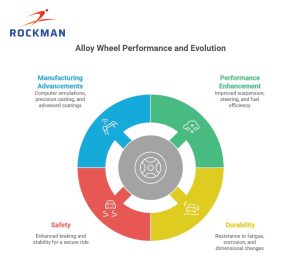
The most significant advantage of alloy wheels lies in reduced unsprung mass.
Lower unsprung weight:
- Improves suspension responsiveness
- Enhances steering precision
- Reduces stress on braking and suspension systems
- Contributes to better fuel efficiency and EV range
Just as important is the management of heat, and alloy wheels do this better than steel rims. This provides better braking performance even after several stops.
Lifecycle Performance and Long-Term Reliability
The real test of an alloy wheel is not its gleaming finish but its ability to perform year after year. Alloy wheel reliability is measured by its ability to withstand the test of time based on the following factors:
- Fatigue resistance
- Corrosion resistance
- Dimensional stability
Alloy wheels may be fashionable, but if the making is not up to the mark, problems can occur in the future.
How Alloy Wheel Technology Is Evolving
Modern alloy wheel manufacturing has shifted decisively toward engineering-led development.
The major advances are:
- Using computer simulations to predict how stress will behave
- Precision casting for perfect distribution of materials
- High-precision machining for perfect balance and fit
- Using advanced coatings to improve corrosion and fatigue resistance
The emphasis is no longer just on making it look different but on making it work well and reliably.
Rockman’s Contribution
Rockman uses a very methodical approach to the manufacturing of alloy wheels by validating each step of the process, from the designing and casting phase to the machining and testing phase, by simulation of the actual usage of the alloy wheel. They use the same engineering standards as those of the OEM for the manufacture of OEM as well as aftermarket alloy wheels, which results in good performance, durability, and safety throughout the lifecycle of the wheel.