
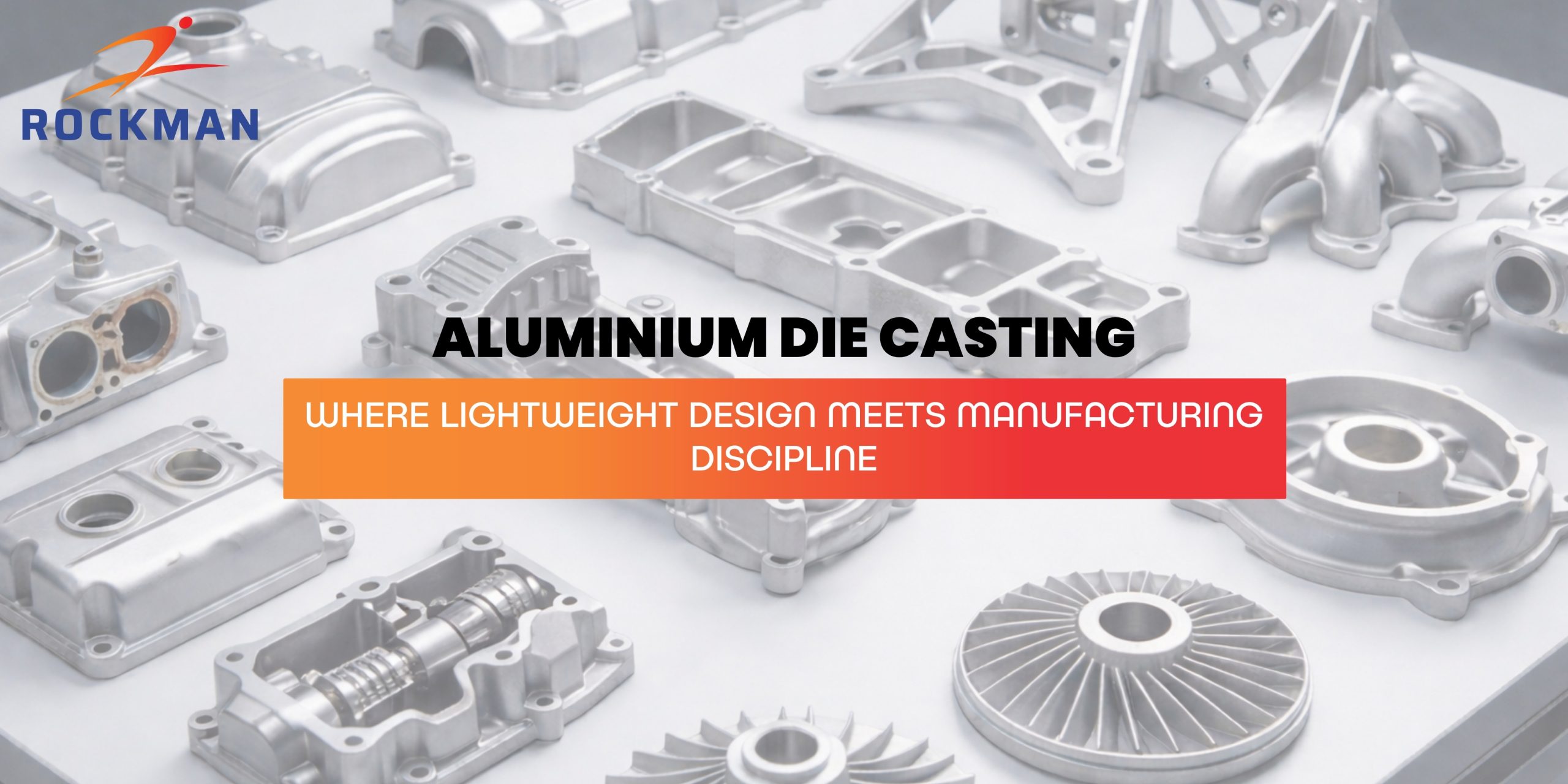
Aluminium die casting is the unsung hero of modern automobiles. It can be seen in how light or heavy a car is, how it runs on fuel, how it performs in heat, and how long it lasts. It’s not just about convenience; it’s about delivering intricate and light-weight parts in huge volumes with quality control. While cars get more and more demanding with emissions, safety requirements, and electric vehicles, aluminium die casting has moved from being a manufacturing process to a capability in its own right.
Products Manufactured in Aluminium Die Casting
Rockman manufactures a wide range of aluminium die-cast components, including:
- Engine and transmission housings
- Gearbox and clutch covers
- Structural and load-bearing automotive components
- Motor housings and battery housings for electric vehicles
These components are central to vehicle architecture. They determine how the load is distributed, how the heat is handled, and how efficiently the vehicle will perform in its lifetime.
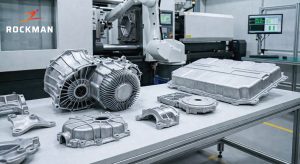
End Usage and Functional Applications
Aluminium die-cast components are used across:
- Two-wheelers and passenger vehicles
- Powertrain and transmission systems
- Structural assemblies and mounting systems
- Electric mobility platforms
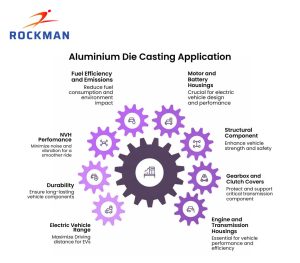
Their primary objective is to reduce weight from the vehicle without compromising strength, accuracy, or thermal stability. These choices impact:
- Fuel efficiency and emissions
- NVH performance
- Durability
- Electric vehicle range
In some cases, aluminum die-cast components are used to replace heavier, multi-piece steel components, which simplifies design and results in predictable performance.
Manufacturing and Process Logic
Aluminium die casting is not a single process; it is a range of processes, each chosen according to the required function in service.
- Gravity die casting is chosen for applications requiring greater structural integrity, greater section thickness, and better metallurgical properties.
- Low-pressure die casting is chosen for applications requiring controlled filling and enhanced mechanical properties.
- High-pressure die casting is chosen for applications requiring thin section complex parts and high volume with close tolerances.
The choice of process depends on load, geometry, volume, and life requirements. Wrong process choice can lead to premature fatigue, distortion, or unnecessary cost escalation.
The Move into Advanced Composites
Aluminium die casting is our bread and butter, but we know it isn’t the only answer to lightweighting. Through Rockman Advanced Composites, we have ventured into carbon fibre. This isn’t just for show; we are delivering real-world parts for motorsports, luxury cars, and even aerospace. We see this as the peak of advanced manufacturing solutions for OEMs.
Mastering both metals and composites gives us more flexibility in developing a much more refined vehicle architecture that very few companies can claim. Visitors visiting our stand in Jan 2026 will also see our shift toward modularity. We aren’t just casting metal; we are delivering full assemblies. We handle the legwork of coordinating with suppliers for things like bearings, seals, and springs so we can deliver “plug-and-play” units, such as wheel hub assemblies, straight to your assembly line.
It’s a way to cut out the logistical mess for our clients. Since we manage the whole stack, you don’t have to worry about whether every small sub-component is going to line up correctly—it just works.
Quality, Validation, and Reliability
In the case of aluminium die casting, small defects can result in major problems. Porosity, shrinkage, and changes in dimensions can result in reduced fatigue and structural properties. Reliability is based on four pillars:
- Alloy content control
- Tool and die precision
- Process parameter control
- Verification in real working conditions
Quality here is not inspected at the end—it is built into the process from the first design decision.
Technology Evolution in Aluminium Die Casting
Aluminium die casting technology of today is informed by data and forward-looking insights. Some of the prominent trends in this direction are as follows:
- Designing molds and fine-tuning processes with simulation at the forefront
- Automated casting systems with repeatable results
- Technologies used to create castings of electric vehicles with high integrity
- Increasing the use of recycled materials and reducing energy use.
The approach has changed from correcting defects to stopping them before they occur.
Rockman’s Contribution
Rockman takes aluminium die casting as an engineering activity, not just another factory activity. It considers how materials behave, how processes are selected, tools are developed, parts are machined, and quality systems are implemented in relation to how components actually function in real-world applications. By applying OEM-grade quality to both conventional and electric mobility platforms, Rockman supplies aluminium die-cast components that are reliable and scalable.