
The modern foundry environment is rich with opportunity; the high-end technical standards set just five years ago have now paved the way for breakthrough advancements. This acceleration is a direct consequence of the global auto industry’s overwhelming commitment to electric vehicles.
Auto Original Equipment Manufacturers (OEMs) are specifying specifications for components that entirely reset expectations for strength, low mass, and material purity. The true measure of this new industrial reality will be found at EUROGUSS 2026, the premier international trade fair for die-casting technology, scheduled from 13 to 15 January in Nuremberg, Germany.
The Dynamics of the New Age Automotive Industry
The sheer size of the opportunity facing the die-casting sector is undeniable. Modor Intelligence predicts the global market for die-casting is around $88 billion USD in 2025, and is expected to climb past $121 billion USD by 2030, an annual growth rate of over six per cent. This trajectory is entirely propelled by the increasing aluminium content in electric vehicles.
The fundamental design principle for any EV is range. Everything that adds mass to the vehicle directly detracts from its efficiency. Therefore, every gram a supplier can shave off a component, will matter. The old objective of ‘lightweight yet strong’ no longer sets a manufacturer apart; it is merely the minimum requirement to be considered.
Automotive parts manufacturers in India must operate with this global landscape in mind. The ability to deliver components that minimise weight while guaranteeing passenger safety and structural durability is the true measure of a world-class supplier. Their work focuses on advanced aluminium pressure die casting techniques that create components that manage these competing demands.
From Seventy Parts to One: The Giga-Casting Dilemma
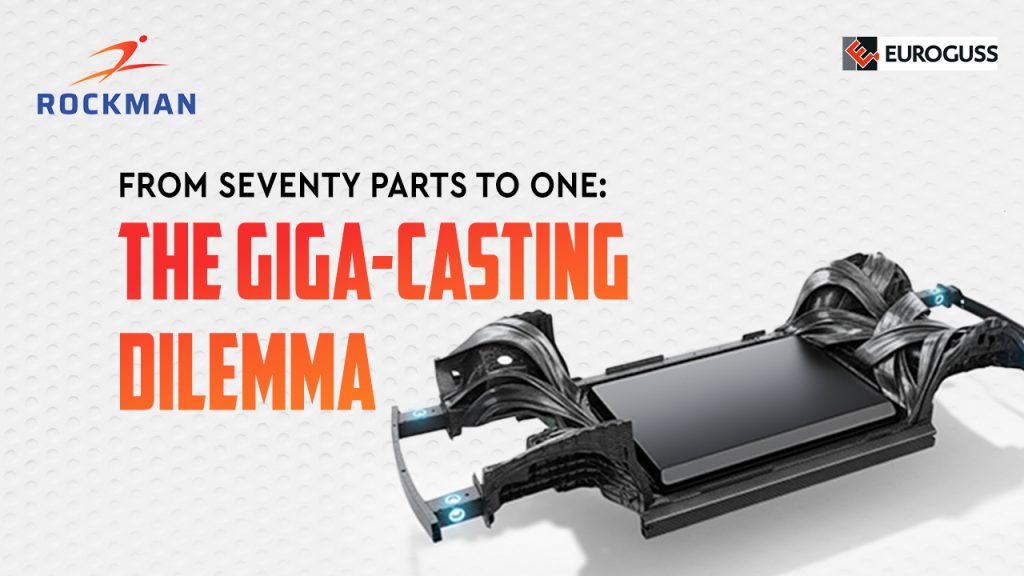
A few years ago, we watched as an electric vehicle manufacturer began installing enormous 6,000-tonne presses. They used these heavy-capacity presses to cast large sections of the chassis in a single piece. Before this innovation, that same area would have needed seventy separate components welded together. The scale of this change is staggering. The seventy-step process became one.
The sheer volume of aluminium now expected in vehicles is confirming the EV market’s permanent establishment, not just its impending arrival. Analysts suggest that the average light-duty vehicle will contain roughly 250 kilograms of aluminium by 2026, most of which will be sourced as die-cast components.
The technology that underpins this growth is undeniably High-Pressure Die Casting (HPDC). HPDC remains a proven method capable of mass-producing the intricate, thin-walled forms needed for structural chassis elements and battery casings.
This essential role is reflected in the segment’s financial outlook, with the HPDC market specifically anticipated to grow past $55 billion USD by 2030. For manufacturers, this trend is both a huge chance and a genuine risk.
Sustainability: A Pre-Requisite in Modern Manufacturing
The conversation surrounding environmentally sound manufacturing practices has matured. For die-casting, the focus is now entirely on economics. Take aluminium recycling: it consumes approximately 95% less energy than producing new metal from its primary source. That is not a marginal saving; it is a significant reduction in operational costs that immediately benefits the P&L statement.
This trajectory is not speculative; it is anchored in firm production mandates. In the evolution of mobility, efficiency is the ultimate metric. By mastery of lightweighting, we reduce battery dependency and advance the sustainability that the modern world demands. The International Aluminium Institute estimates that global demand for aluminium die-cast products will increase by 50% by 2034.
This is not an arrow shot in the dark; it is based on signed production commitments for electric vehicles. When manufacturing an EV, the goal is always to deliver better range and enable smaller batteries, making lightweighting and sustainability two sides of the same coin.
The Smart Foundry: Where Quality is Non-Negotiable
The speed of modern aluminium pressure die casting has simply outpaced the human ability to monitor it. This is the driving force behind the integration of Industry 4.0 systems. The global market for AI in manufacturing is expanding by 23% every year, a testament to its necessity.
The sheer speed and tightly controlled complexity of contemporary casting lines have definitively exceeded the limits of human monitoring capacity. These processes are too rapid and intricate to ensure quality checks manually. Consequently, the core function of quality control within the foundry is being transferred entirely to advanced AI systems, which are uniquely suited to manage this level of complexity.
These function as a continuous, sensory network, constantly scrutinising the essential parameters, including injection speed, metal temperature, and the exact pressure curves. The AI’s capabilities are crucial: it spots minute, developing issues, such as early formation of gas porosity or slight irregularities in the mould fill, far earlier than any human eye could, and often executes the necessary process adjustment autonomously.
Crucially, they can then autonomously fine-tune the process to correct and eliminate the flaw. This dramatically improves quality, consistency and reduces the expensive scrap rate.
Away from the foundry floor, ‘Digital Twins‘ are becoming standard tools. This technology creates a virtual replica of the entire production line. Engineers can test new tooling, try different alloys, and push process limits in a simulated environment. They can break things and fix them virtually, finding potential problems and optimising production without wasting a moment of actual shop floor time or material.
For auto parts manufacturers in India who aspire to global Tier 1 status, adopting this level of digital oversight is non-negotiable. Quality standards for EV components are too tight and margins too thin to manage manually.
HPDC Underpins the Electric Vehicle Boom
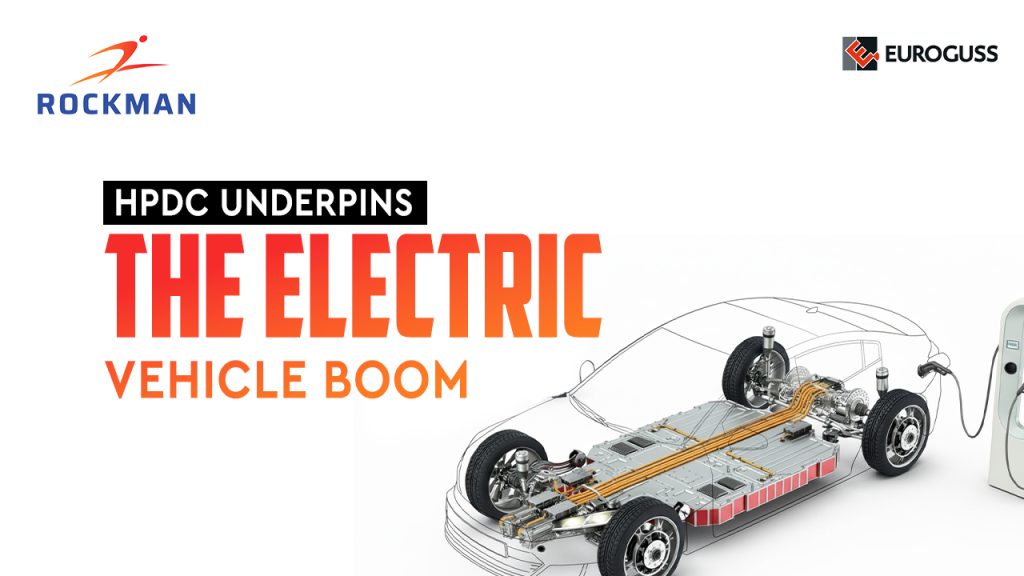
Surging global demand confirms the electric transition; HPDC remains the silent cornerstone of this new industrial era. The technical necessity of using aluminium in modern vehicles is driven by compelling economics. Industry forecasts suggest that by 2026, the average light-duty vehicle will contain roughly 250 kilograms of metal, with most of that volume arriving in the form of die-cast parts.
The reason for this volume is the dominance of High-Pressure Die Casting (HPDC). This process stands as a technologically proven method capable of reliable, high-volume manufacturing for the complex, thin-walled structures.Currently, required for EV battery enclosures and crucial structural chassis components.
Reflecting this necessity, the market segment dedicated to HPDC is anticipated to expand significantly, surpassing $55 billion USD by 2030. A critical refinement is vacuum-assisted HPDC, which is mandatory for battery casings. Standard HPDC can sometimes leave minute air pockets within the metal.
Small air gaps can break the tight seal needed for high-voltage batteries. Our vacuum HPDC pulls that air out, creating a solid, leak-proof part that keeps the entire system safe. It is a more complex process, but for critical EV parts, the added certainty is essential.
Strategy: Rethinking Supply Chains
The brutal commercial lessons learned throughout 2020 and 2021 centred on the direct risks of an over-reliance on single and centralised supply chains. When problems arise in one manufacturing hub, global vehicle production often comes to a grinding halt.
Consequently, the industry has fundamentally re-strategised. The modern preference is for distributed, regional manufacturing networks, specifically designed to inject resilience and flexibility back into the system.
The logic is simple: manufacturing closer to the assembly plant reduces shipping costs, improves delivery speed, and provides a crucial operational buffer when disruptions occur. This physical spread is a significant competitive advantage for auto parts manufacturers in India.
It allows them to expertly serve the rapidly expanding domestic EV market while simultaneously being the ideal partner for global OEMs seeking to de-risk their international supply base.
The Conclusion: Rockman Industries, Engineering the Future of HPDC
EUROGUSS 2026 is not merely a trade show; it is a critical audit of where the industry currently stands today. The market is heading toward $119 billion USD, driven by immediate, transformative changes. For aluminium die casting manufacturers, this demands a clear strategic response.
Rockman Industries, a highly established aluminium die casting manufacturer and a key contender among auto parts manufacturers in India, will be a prominent exhibitor at Hall no. 7, Stand 524. Holding a key position among the world’s serious suppliers, the company’s presence reflects a deep capability to meet and exceed global standards.
Rockman is utilizing the Euroguss’ platform to showcase its readiness for the future. Their objective is unequivocal: to demonstrate sustained excellence in High-Pressure Die Casting (HPDC) and deliver the reliable, precision-engineered solutions that the next generation of vehicles genuinely demands. This is framed by the core message: Precision, Strength, and Lightweighting for the Future of Mobility.
Rockman’s core exhibit will feature components that embody these principles:
- Automotive Safety: Knuckles and Housing Brake Parts highlight structural reliability in safety-critical applications.
- Precision and Performance: The Throttle Body demonstrates the ability to hold tight tolerances for complex fluid dynamics.
- Mass Reduction: The Alloy Wheel showcases lightweighting expertise combined with aesthetic and structural durability.
Rockman Industries, an aluminium die casting manufacturer, operates multiple plants spanning across India, giving them essential proximity to major domestic and international clients such as TVS, Honda and Hero Motor Corp. This setup positions them as a reliable and comprehensive supply partner.
The conversations that begin at this stand in Nuremberg will determine not who plans for the future, but who has already built it.